UX/UI Design · Product redesign · Industry
Sepro Group
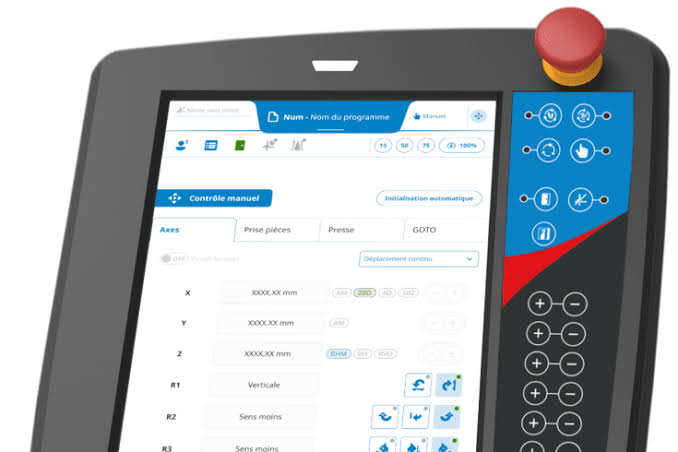
Design of the next generation of the control system developed by Sepro Group to operate its injection-molding robots, replacing the previous system, in service for about fifteen years. Sepro Group is a global leader in automation for plastic injection molding, present across a wide range of sectors: automotive, medical and pharmaceutical, luxury, packaging, household appliances, and electronics.
Client
Sepro Group - R&D
Role
UX/UI Designer
Duration
20 months
Deliverables
UX research, mockups, QA specs
01
Context & Problem
The existing system had been used for about fifteen years to operate, monitor production, program, and maintain Sepro robots. Beyond an aging user experience and design, the redesign was also made necessary by a hardware evolution: a change of electronic boards and a switch from a 4/3 screen format to a 9/16 format.
How can we turn an industrial tool into a modern, seamless, and intuitive solution, while preserving all of its essential existing features?
The whole difficulty of the project lay in this last constraint: thoroughly modernizing a critical industrial tool without losing any of the essential features that experienced operators rely on every day.

02
Approach
I joined Sepro Group's R&D department as a UX and then UX/UI designer, within a UX/UI team of 4 and later 3 people, following an agile Scrum methodology with two-week sprints, working closely with the development teams.
UX writing: microcopy was written through constant back-and-forth with subject-matter experts, dealing with highly technical vocabulary specific to industrial robotics (multi-axis control, vacuum sensors, external axis tracking...).
User testing: I was in charge of organizing it end-to-end, writing the interview guide and building the prototype, running and analyzing the interviews, communicating insights to the team, then iterating on the interfaces accordingly.
Field tests: we also traveled directly to client sites to observe the product in development running under real conditions and gather their UX impressions firsthand, in addition to the tests run internally.
Ergonomics and ideation workshops with the design team, to propose alternative mockups and flows for a given feature before converging on a solution.
UX QA: checking UX specifications directly within the development builds, together with developers, to ensure fidelity between design and implementation.
In parallel, I also led the entire UX research effort on a desktop editor within the Sepro ecosystem: around fifteen user interviews and a survey gathering about fifty responses, to determine needs and identify UX pain points in the existing tool.
To gain consistency across the whole product, I took part in setting up a design system on ZeroHeight, built in Figma by the UX/UI team: more than 500 screens have been designed relying on this design system.
+500
screens designed using the design system
+60
user tests conducted over the course of the mission
+20
user interviews conducted over the course of the mission
03
Result
The project delivered a complete redesign backed by research (benchmarks, user testing, interviews), a full set of mockups covering the entire product journey, and UX QA specs ensuring implementation fidelity.
- — A complete immersion in a highly technical, industrial environment, with demanding domain vocabulary and expert users.
- — A strengthened practice of listening and self-questioning, necessary when facing subject-matter experts who challenge every proposal with concrete operational rigor.
- — A documented design system on ZeroHeight, now supporting more than 500 screens, built to stay consistent over the product's lifetime.